

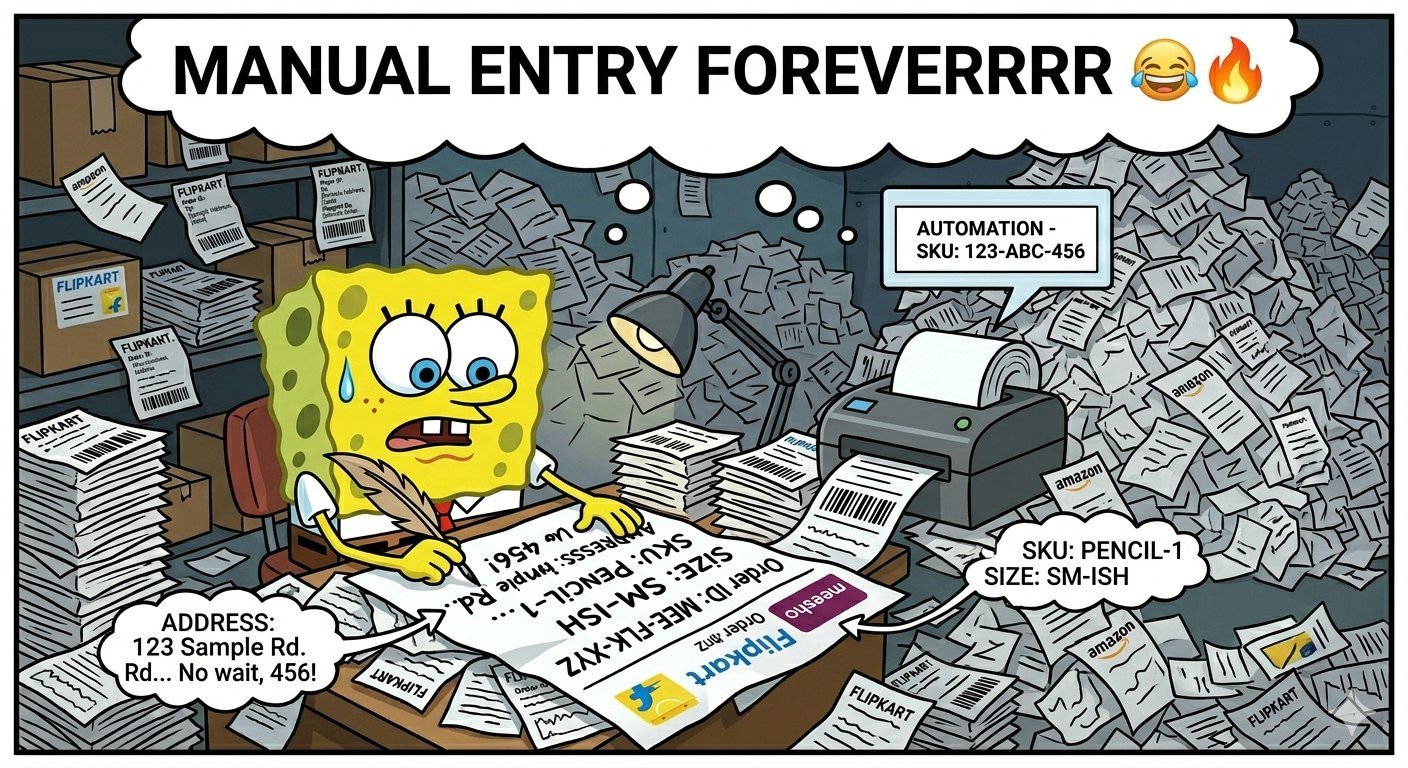
As an e-commerce seller's daily order volume scales from 10 orders to 50 or 100, relying on memory, handwriting item names on boxes, or manually editing labels to add product details becomes the primary driver of fulfillment failure. Shipping the wrong size, color variation, or product model not only damages your seller score on Meesho and Flipkart but directly burns profit through reverse logistics charges and dissatisfied buyers.
The foundation of error-free fulfillment is a standardized Stock Keeping Unit (SKU) architecture that integrates directly into marketplace catalog listings and automatically prints on every courier shipping label.
Principles of a Robust SKU Naming Convention
An effective SKU should be human-readable by warehouse packers yet structured enough for database sorting. Avoid using spaces, special characters, or symbols (like / or *) that can break barcode formatting. Keep SKU lengths between 8 and 14 characters.
| Segment | Code Position | Example Value | Decoded Meaning |
|---|---|---|---|
| Category Prefix | Chars 1-3 | KUR | Kurti / Women's Ethnic Wear |
| Design / Style ID | Chars 4-7 | 1042 | Specific floral embroidery pattern |
| Color Code | Chars 8-10 | NVY | Navy Blue |
| Size Designation | Chars 11-12 | XL | Extra Large (42-inch chest) |
| Complete Output SKU | Full String | KUR-1042-NVY-XL | Navy Blue Embroidered Kurti, Size XL |
How to Ensure SKUs Print on Meesho and Flipkart Labels
- During initial catalog listing or catalog editing, populate the 'Seller SKU' or 'Product ID' field with your structured code.
- Ensure every size and color variant has an independent, unique SKU (e.g. KUR-1042-NVY-M and KUR-1042-NVY-L must never share the same code).
- When downloading shipping labels, both Meesho and Flipkart automatically include the SKU in the item description box near the bottom of the courier label.
- Packers can now match the physical garment tag directly to the printed label SKU without opening the order dashboard or guessing product contents.
Implementing a Packing-Station Verification Check
To eliminate wrong-item dispatches entirely, require packers to cross-reference the SKU printed on the courier label against the internal barcode or sticker on the product's polybag. If your operation uses handheld wireless barcode scanners, scanning the product SKU and label SKU sequentially ensures the parcel is verified before sealing.



Comments (0)
Log in to join the discussion.