

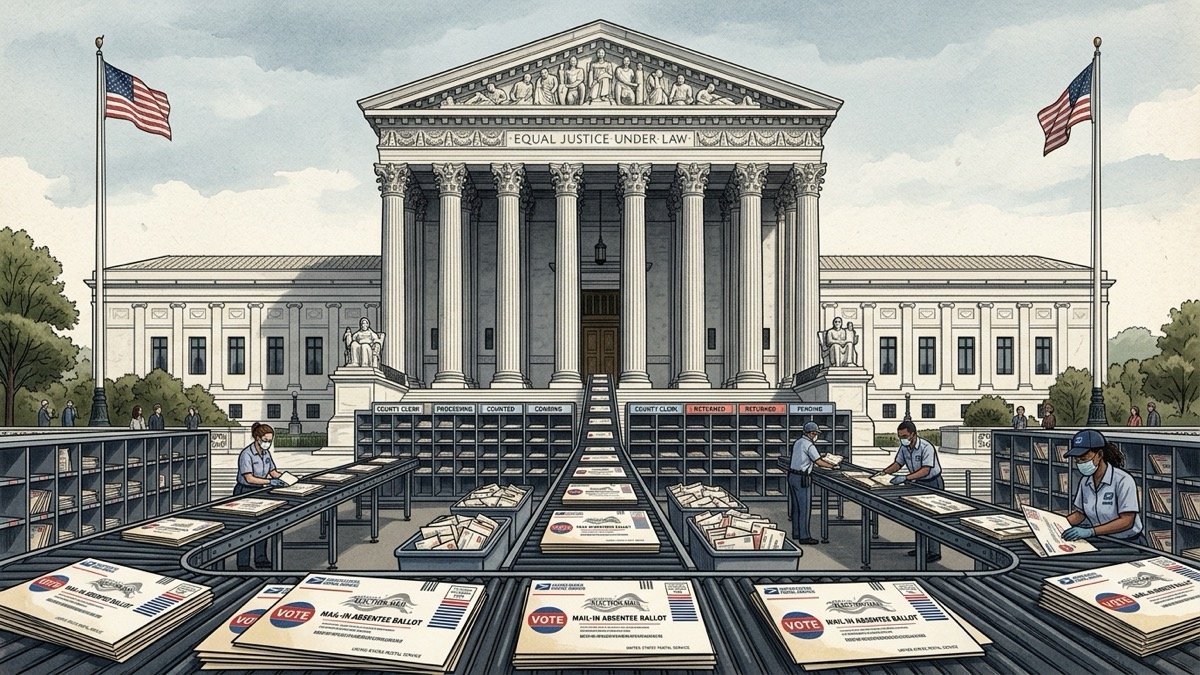
The United States Supreme Court has refused to reinstate a set of contested Postal Service delivery regulations that would have altered how mail-in absentee ballots are handled in the upcoming November 2026 midterm elections. In an unsigned emergency order, the justices denied the federal government's application for a stay, preserving a lower court preliminary injunction that blocked the rules from taking effect.
The litigation centered on administrative guidelines proposed by the U.S. Postal Service that would have required state election boards to submit ballot envelope layouts for pre-clearance and authorized postal processing centers to withhold delivery of election mail that did not conform to rigid standardized barcode specifications.
Kavanaugh Concurrence and the Purcell Principle
In a notable concurring opinion, Justice Brett Kavanaugh explained that while the Postal Service may possess underlying statutory authority to regulate mail formats under ordinary circumstances, attempting to enforce major procedural changes immediately prior to a nationwide vote violated the established legal principle against last-minute election disruption.
| Judicial Factor | Order Position | Legal Precedent / Rationale | Election Impact |
|---|---|---|---|
| Majority Order | Application for stay denied | Government unlikely to succeed on merits; equities favor stability | Mail-in voting proceeds under existing state election laws |
| Kavanaugh Concurrence | Concurs in denial of stay | Purcell principle: altering voting rules on the eve of elections causes chaos | Local election boards avoid re-printing tens of millions of ballots |
| Dissent (Thomas & Alito) | Would have granted stay | Postal Service possesses broad administrative authority over mail standards | Highlights unresolved statutory tensions for future review |
| Operational Directive | Enjoins USPS restrictions | USPS must deliver all valid state election mail without delay | Safeguards delivery of absentee ballots across all 50 states |
Dissent and Broader Electoral Implications
Justices Clarence Thomas and Samuel Alito filed a brief dissent, indicating they would have granted the government's stay application. The dissenting justices noted that postal operations involve complex logistics and that federal courts should exercise restraint before micromanaging internal agency sorting directives.
The ruling provides immediate certainty for state secretaries of state, county election clerks, and overseas military voters. With absentee balloting already underway in several states, postal processing centers will continue to prioritize all election-related mail under standard expedited delivery protocols without imposing technical rejection filters.



Comments (0)
Log in to join the discussion.