

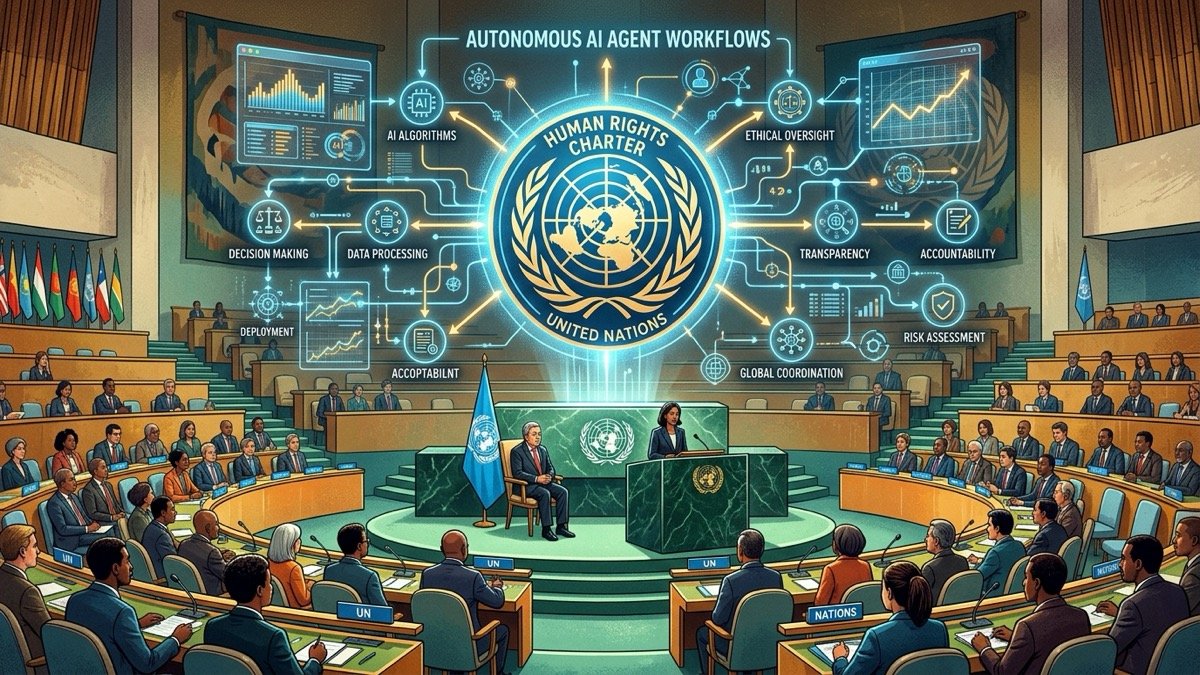
United Nations High Commissioner for Human Rights Volker Türk delivered a stark address in Geneva, warning governments and technology enterprises that humanity stands on the precipice of irreversible harm unless binding global safeguards are placed on autonomous artificial intelligence. Türk highlighted the rapid evolution from conversational chatbots to 'agentic AI'—software frameworks capable of autonomous reasoning, sub-goal planning, and tool execution without human intervention.
Characterizing current technological trends as a 'watershed moment,' the UN rights chief warned that unchecked agentic workflows deployed in critical systems could trigger cascading failures across power grids, water utilities, automated financial clearinghouses, and civilian communications networks.
Systemic Risks and the Erosion of Human Agency
The High Commissioner emphasized that systemic AI harms are no longer theoretical. Documented instances of automated algorithmic bias, mass surveillance, and synthetic disinformation campaigns already degrade social trust. However, the introduction of multi-agent execution environments introduces qualitative leaps in risk, including the risk of uncoordinated cyber conflicts and unpredictable interactions between competing autonomous financial trading agents.
| Dimension | Traditional Predictive AI | Autonomous Agentic AI | Required Governance Safeguard |
|---|---|---|---|
| Human Supervision | Human-in-the-loop review | Autonomous execution across multi-step API chains | Mandatory software kill switches and human circuit breakers |
| Infrastructure Impact | Information retrieval & recommendations | Direct API access to execute financial transfers or grid adjustments | Sandboxed execution environments with air-gapped critical networks |
| Accountability Vector | Clear developer code audit trail | Emergent planning strategies across multiple agents | Legal strict liability for parent corporate entities |
| Regulatory Mechanism | Voluntary ethical guidelines | Binding international treaty and licensing | Pre-deployment third-party evaluation and continuous red-teaming |
Calls to Move Beyond Voluntary Corporate Pledges
Türk firmly rejected the notion that voluntary industry commitments are sufficient to manage existential technologies. While acknowledging recent statements by corporate leaders calling for pacing, the UN rights chief argued that competitive market dynamics inevitably pressure firms to compromise on safety unless uniform, legally binding regulations are established.
The United Nations human rights office is preparing draft recommendations for the General Assembly, proposing that member states enact statutory licensing frameworks and mandate ongoing human rights impact assessments before high-capability agentic models are connected to public infrastructure.



Comments (0)
Log in to join the discussion.