

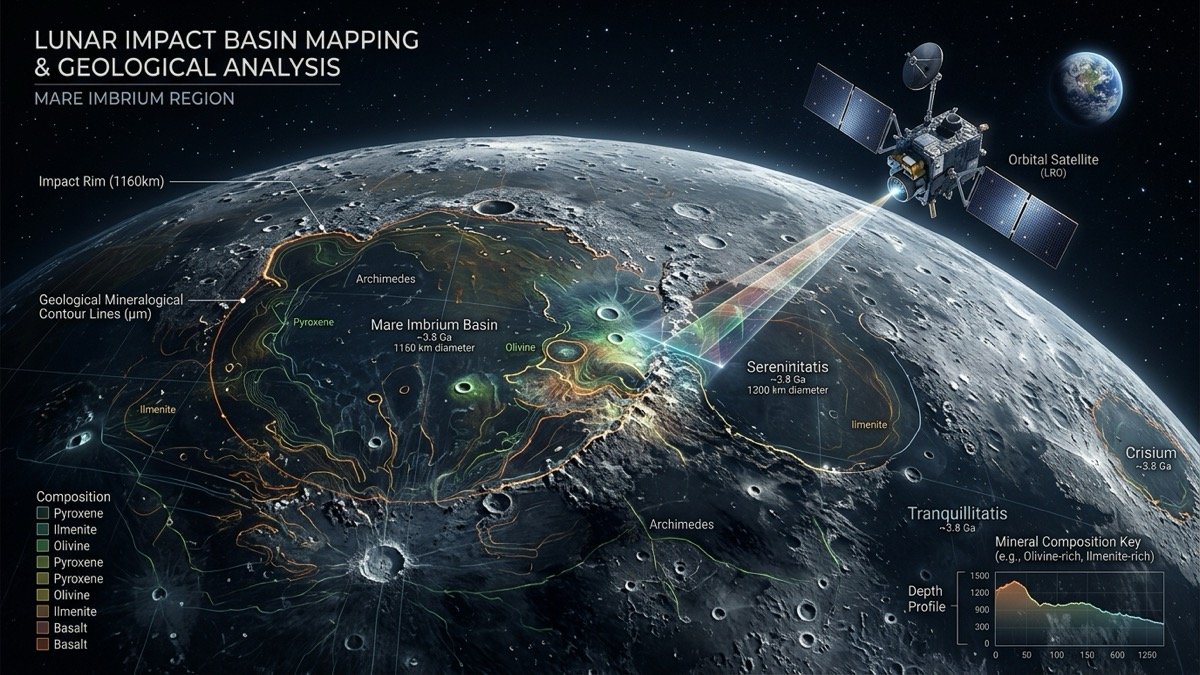
Planetary geologists at the Physical Research Laboratory (PRL) in Ahmedabad, an autonomous unit under India's Department of Space, have confirmed the identification of one of the Moon's oldest and most heavily degraded impact structures. Named the 'Australe Basin,' the massive crater complex was identified through advanced re-processing of hyperspectral data gathered by the Moon Mineralogy Mapper (M3) aboard India's historic Chandrayaan-1 mission.
The discovery, published in leading peer-reviewed planetary science archives, offers unprecedented insight into the earliest epoch of lunar geological evolution. Stratigraphic and mineralogical analyses indicate that the Australe Basin pre-dates the colossal South Pole-Aitken (SPA) basin, which has long been considered the oldest confirmed impact depression on the Moon.
Mineral Signatures and Subsurface Excavation
The PRL research team, led by senior planetary scientists, utilized high-resolution infrared reflectance spectra to analyze the chemical composition of central peaks and crater rims across the lunar southern farside. The data revealed distinctive absorption bands corresponding to low-calcium pyroxenes and plagioclase-rich anorthosite, characteristic of rocks excavated from deep within the primordial lunar crust.
| Impact Basin | Estimated Diameter | Geological Era | Mineral Signature (M3 Data) |
|---|---|---|---|
| Australe Basin (Newly Confirmed) | ~1,100 km degraded rim | Pre-Nectarian (>4.3 Billion Years) | Low-calcium pyroxene with excavated deep anorthositic crust |
| South Pole-Aitken (SPA) | ~2,500 km diameter | Pre-Nectarian (~4.2–4.3 Billion Years) | Mantle-derived noritic materials with high iron content |
| Imbrium Basin | ~1,160 km diameter | Imbrian (~3.85 Billion Years) | Basalt-flooded mare deposits rich in titanium and ilmenite |
| Orientale Basin | ~930 km diameter | Early Imbrian (~3.75 Billion Years) | Multi-ring concentric mountain scarps with fresh ejecta |
Implications for Early Solar System Bombardment
The identification of a giant basin older than South Pole-Aitken has substantial implications for models of the Late Heavy Bombardment, a hypothesized period roughly four billion years ago when an intense surge of asteroids struck the inner solar system. The existence of the Australe Basin suggests that large impactors were active well before the cataclysmic peak, pointing toward a prolonged and steady bombardment history.
ISRO scientists noted that the discovery underscores the enduring scientific value of legacy space mission data. The findings will help refine landing site selection and in-situ resource exploration strategies for upcoming international missions under India's Chandrayaan program and partner lunar landers.



Comments (0)
Log in to join the discussion.